China remains the world’s largest fabric supplier, but the latest trade figures tell a more complicated story than the headline volumes suggest. For buyers sourcing woven fabric, understanding this shift matters — because it changes how you should evaluate a supplier.
The numbers: more meters, thinner margins
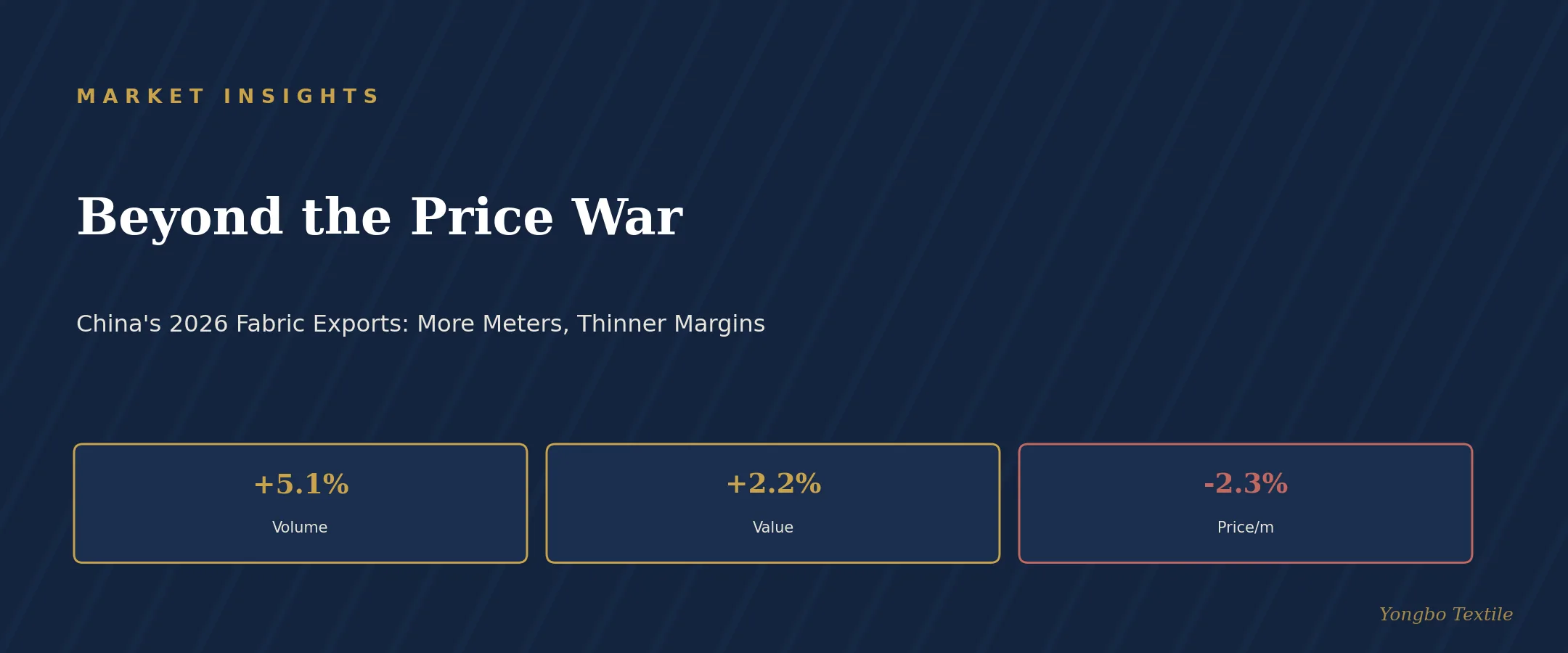
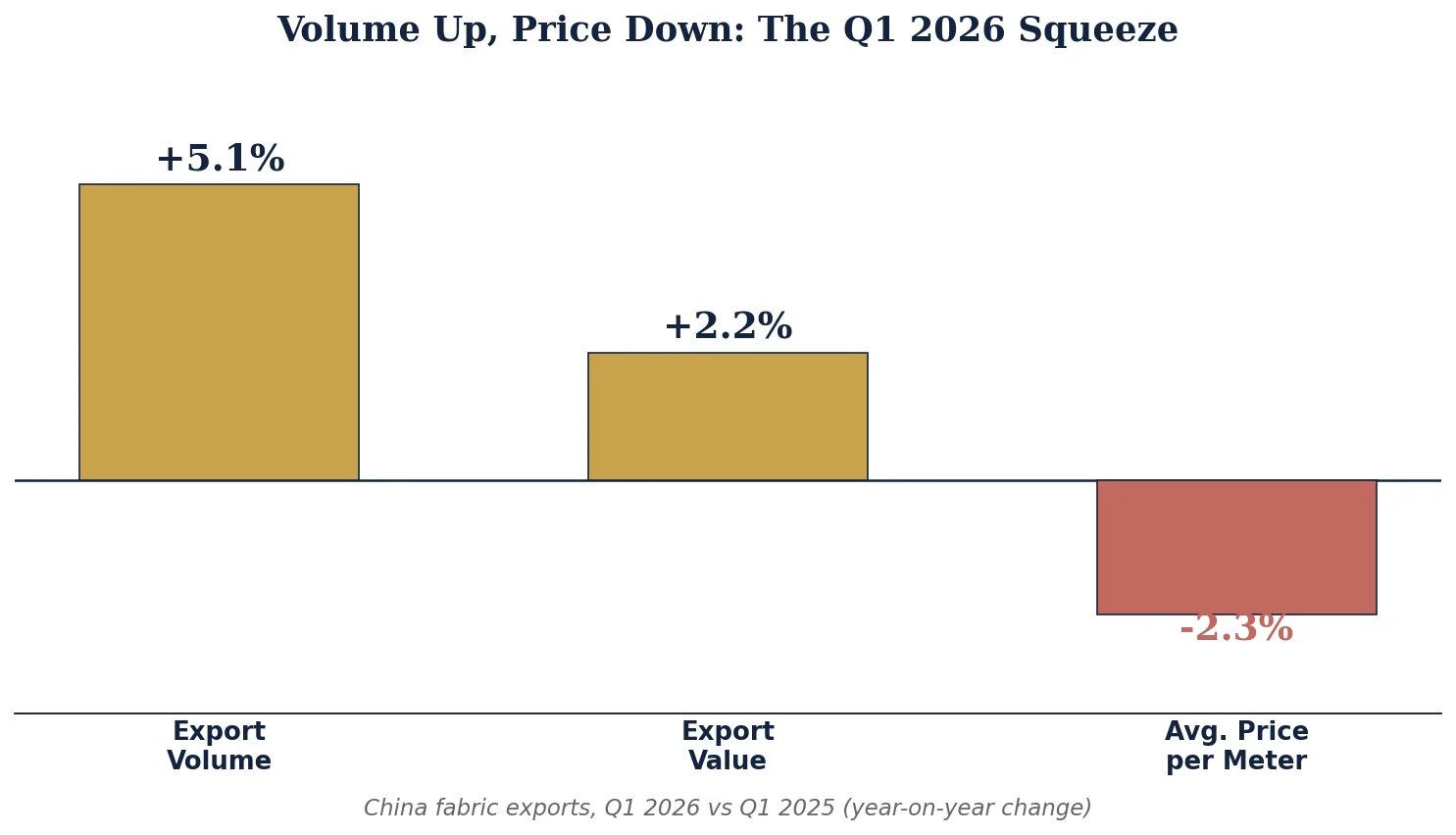
In the first quarter of 2026, China exported roughly 12.86 billion meters of fabric, up about 5% year on year, with export value reaching around USD 16.2 billion. On the surface, that is healthy growth and confirms that global demand for Chinese fabric remains solid.
But the average export price slipped to about USD 1.26 per meter, down from USD 1.29 a year earlier — a decline of roughly 2.3%. The same downward trend shows up whether you measure by weight or by square meter, which means this is not a quirk of one product category. It is broad, system-wide price pressure.
In plain terms: the industry is selling more fabric for less money per unit. Volume is up, but the value captured per meter is shrinking.
Why prices are falling even though demand is stable
Demand itself has not collapsed. Core categories — synthetic-fiber fabrics, cotton fabrics, and functional fabrics — all posted volume growth in the 4–6% range, a sign that international buyers still trust Chinese mills for quality consistency and delivery reliability.
The pressure comes from two directions at once:
- External competition. Production capacity in Southeast and South Asia keeps expanding. With lower labor and manufacturing costs, these regions are absorbing a share of international orders, especially for commodity-grade fabric.
- Internal oversupply. Within China, intense homogeneous competition pushes smaller mills to cut prices to win orders, and even larger players feel the drag.
At the same time, soft consumer recovery in the US and EU has strengthened buyers’ negotiating position, pulling the price center lower still.
The warning inside the data
The quarter also showed a clear “strong start, weak finish” pattern. January and February held steady, lifted by pre-Lunar-New-Year order rushes. March then dropped sharply, with both export value and volume falling by more than 30% year on year.
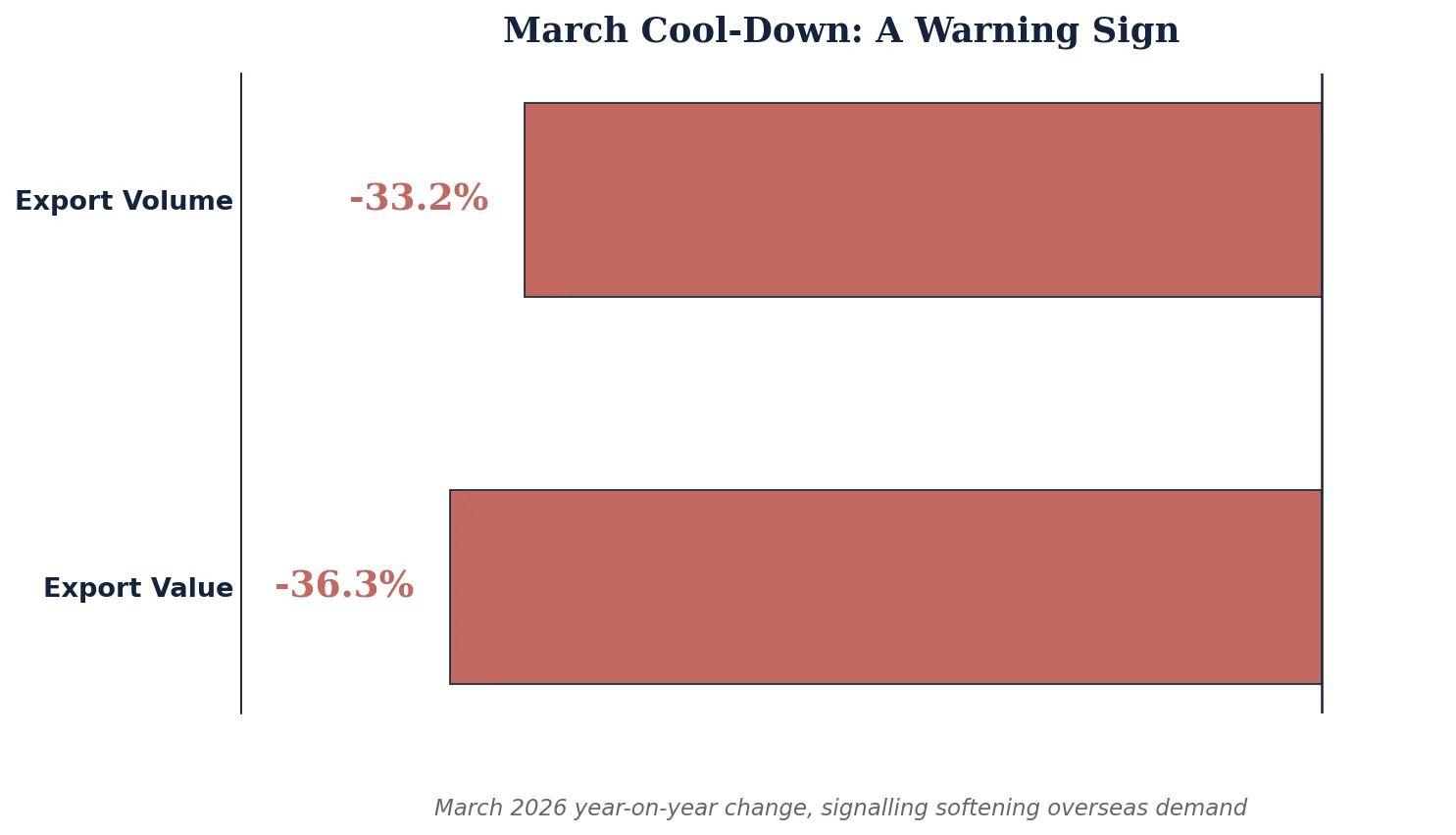
Part of that is calendar distortion and a high base from the previous year. But it also reflects a real concern: marginal cooling in overseas demand. For buyers, the takeaway is not panic — it is that the era of simply riding ever-growing volume is ending.
What this means when you choose a supplier
Here is the part that matters for sourcing decisions. When an entire industry competes on price, the cheapest quote is often the riskiest one. Mills that survive only by undercutting tend to cut corners somewhere — on dye recipes, on shrinkage control, on inspection, on consistency between reorders.
The more durable suppliers are moving in the opposite direction: investing in higher-value, differentiated fabric (functional finishes, performance constructions, traceable sustainable production) and competing on capability rather than on being the lowest number on a quote sheet.
For a buyer, a few practical signals separate a resilient partner from a price-war casualty:
- Traceable production. Can the supplier control and document the chain from greige to finished fabric, rather than buying anonymous stock and reselling it?
- Consistent reorders. Will the color and hand-feel you approve today still match six months from now? This is where cheap mills quietly fail.
- Audit-ready transparency. Can they pass a real factory audit, with lab data on fastness, shrinkage and tensile strength?
- Differentiation over commodity. Do they offer functional finishes and customization, or only race-to-the-bottom basics?
The bigger picture
China’s textile industry is shifting from “expansion by scale” toward “competitiveness by quality and value.” The mills that come out ahead will be the ones whose real strength is built into every meter — in technical content, in reliability, and in the ability to hold a fair price because the value is genuinely there.
For global buyers, the 2026 data is both a report card and a quiet warning. In a supply chain that is being reshaped, the lowest price is not the same as the best value. Choosing a supplier with genuine production control and a clear quality standard is what protects you when the price war reaches its limits.
At Yongbo Textile, this is exactly the position we have chosen: a vertically integrated mill with our own dyeing-and-finishing base, traceable recipes, audit-ready quality control, and a focus on customizable, functional woven fabric rather than commodity volume. If you are re-evaluating your fabric sourcing in this market, we would be glad to talk.