GSM — grams per square meter — is one of the first numbers buyers ask for, and one of the most misunderstood. It reads like a fixed spec, but fabric weight is actually the end result of a dozen decisions made across weaving and finishing, and even a well-run mill will see some batch-to-batch movement around the target number.
What actually moves the number
Yarn count and density set the starting point, but finishing does most of the fine-tuning. High-temperature steps like pre-shrinking and dyeing cause the fabric to contract, which packs the yarns closer together and pushes weight up. On the stenter, tension works the opposite way — pull the fabric tighter (or run higher “overfeed” the other direction) and weight per square meter goes down as the fabric stretches thinner; ease it and weight goes up. Even something like an alkaline treatment to soften cotton hand can nudge weight in the other direction by making yarns finer. None of these are mistakes — they’re the normal levers a mill uses to hit a target weight while also controlling width, hand and shrinkage at the same time.
How weight should be measured
There’s more than one way to measure GSM, and it’s worth knowing which one your supplier uses:
- Small-sample cutting (die-cut disc or 10×10 cm square) — fast, and the standard method for buyer–mill confirmation on a swatch or lab dip.
- Full-roll or full-batch weighing — weighing an entire piece or dye lot and dividing by area gives a more reliable production-floor average, especially for stretch fabrics where small-sample cutting can be less consistent.
A mill that’s serious about weight control usually checks the first roll off finishing before running the rest of the batch, adjusting stenter settings if needed — that’s the difference between “close enough” and “on spec.”
What tolerance to expect
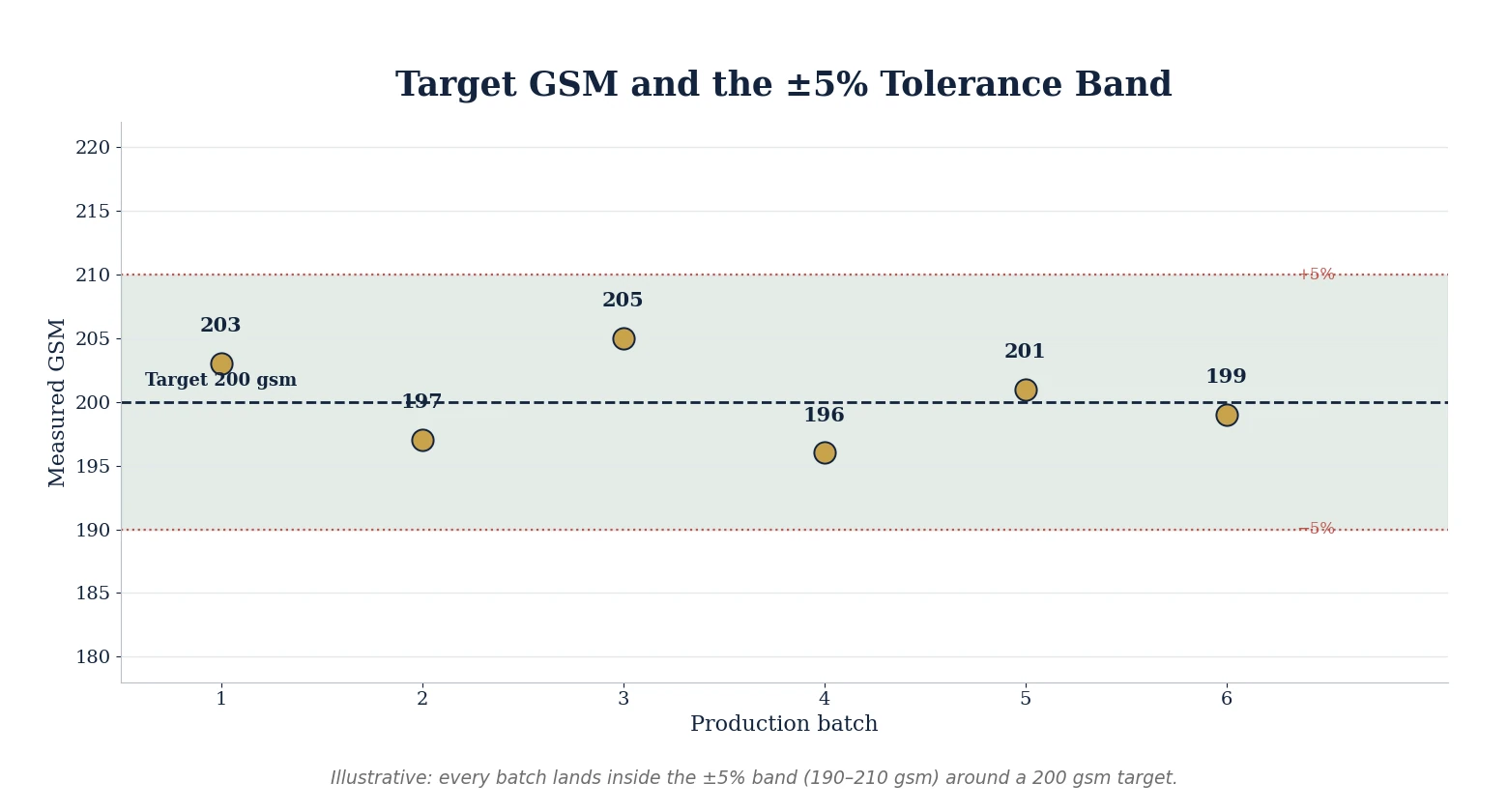
For most woven fabrics, ±5% around the target GSM is a fair and commonly accepted range. If your product is weight-sensitive — technical outerwear, or a program where fabric cost is calculated per kg — it’s worth stating your acceptable tolerance explicitly on the PO rather than assuming, and asking whether the mill checks weight roll-by-roll on larger orders.
At Yongbo Textile, every batch is checked against target GSM during finishing — not just at final inspection — so the fabric you approve on a sample is the fabric you receive in bulk. 🌐 yongbotex.com