Before you specify a fabric, it helps to understand what it’s made of. Every woven fabric starts with fiber, and each fiber brings its own strengths and trade-offs. This guide covers the five fibers you’ll meet most often in apparel and workwear sourcing — what each does well, where it falls short, and what it’s best suited for.
Cotton
The most widely used natural fiber, valued for comfort.
Strengths: Excellent breathability and moisture absorption, soft hand, natural appearance, takes dye well, and stands up to heat and alkaline treatment — which is why it can be mercerized and finished in many ways.
Trade-offs: Wrinkles easily, can shrink (typically 4–12% without treatment), and colorfastness needs proper finishing to hold up.
Best for: Shirting, workwear, casualwear, denim, canvas — anywhere comfort and a natural feel matter. Shrinkage and colorfastness are controllable with Sanforizing and proper dyeing, which is exactly where a quality mill earns its value.
Polyester
The workhorse synthetic, valued for durability and easy care.
Strengths: High strength and abrasion resistance, holds bright color without fading, keeps its shape, resists wrinkles and shrinkage, dries fast, and resists acids and most chemicals. It’s also the most heat-resistant of the common synthetics, which allows permanent pleating and heat-setting.
Trade-offs: Low breathability and poor moisture absorption (can feel warm), builds static in dry conditions, and can pill under abrasion.
Best for: Uniforms, sportswear, outerwear shells, linings, bags — anywhere durability, color retention and easy care are priorities.
Viscose (Rayon)
A regenerated cellulose fiber made from wood pulp, valued for a soft, silk-like feel.
Strengths: The best moisture absorption among common man-made fibers, smooth and lustrous with a silk-like drape, comfortable against the skin, and dyes to rich, vivid colors.
Trade-offs: Weak when wet, wrinkles easily, lower abrasion resistance, and higher shrinkage — which is why it’s usually blended rather than used alone.
Best for: Suiting and dress fabrics (often blended with polyester as T/R), linings, and drapey womenswear. The classic move is to pair viscose’s softness with polyester’s strength — getting the elegant hand without the fragility.
Nylon (Polyamide)
The toughest common synthetic, valued for strength-to-weight.
Strengths: The strongest and most abrasion-resistant of the common fibers, lighter than cotton or viscose, elastic and shape-retaining, and resistant to acids, alkalis, mildew and moths.
Trade-offs: Lower moisture absorption, yellows and weakens under prolonged sunlight, and can pill with heavy wear.
Best for: Outdoor jackets, tactical and military gear, backpacks, ripstop fabrics — anywhere strength and light weight are non-negotiable. Nylon’s tear and tensile strength is why it beats polyester for serious outdoor and gear applications.
Spandex (Elastane / Lycra)
The stretch fiber, almost never used alone.
Strengths: Exceptional stretch and recovery, holds shape without bagging, comfortable and body-conforming, and resists abrasion and ageing.
Trade-offs: Poor moisture absorption, and it must be blended with other fibers to be useful.
Best for: Added in small percentages (typically 2–12%) to cotton, polyester or T/R to bring comfort stretch — stretch chinos, performance wear, modern tailoring. The blend ratio and heat-setting determine whether the stretch recovers cleanly or sags, which separates good stretch fabric from cheap.
The three basic weave structures
Fiber is only half the story — how the yarns are woven shapes the fabric just as much. Almost all woven fabric is built on one of three basic structures:
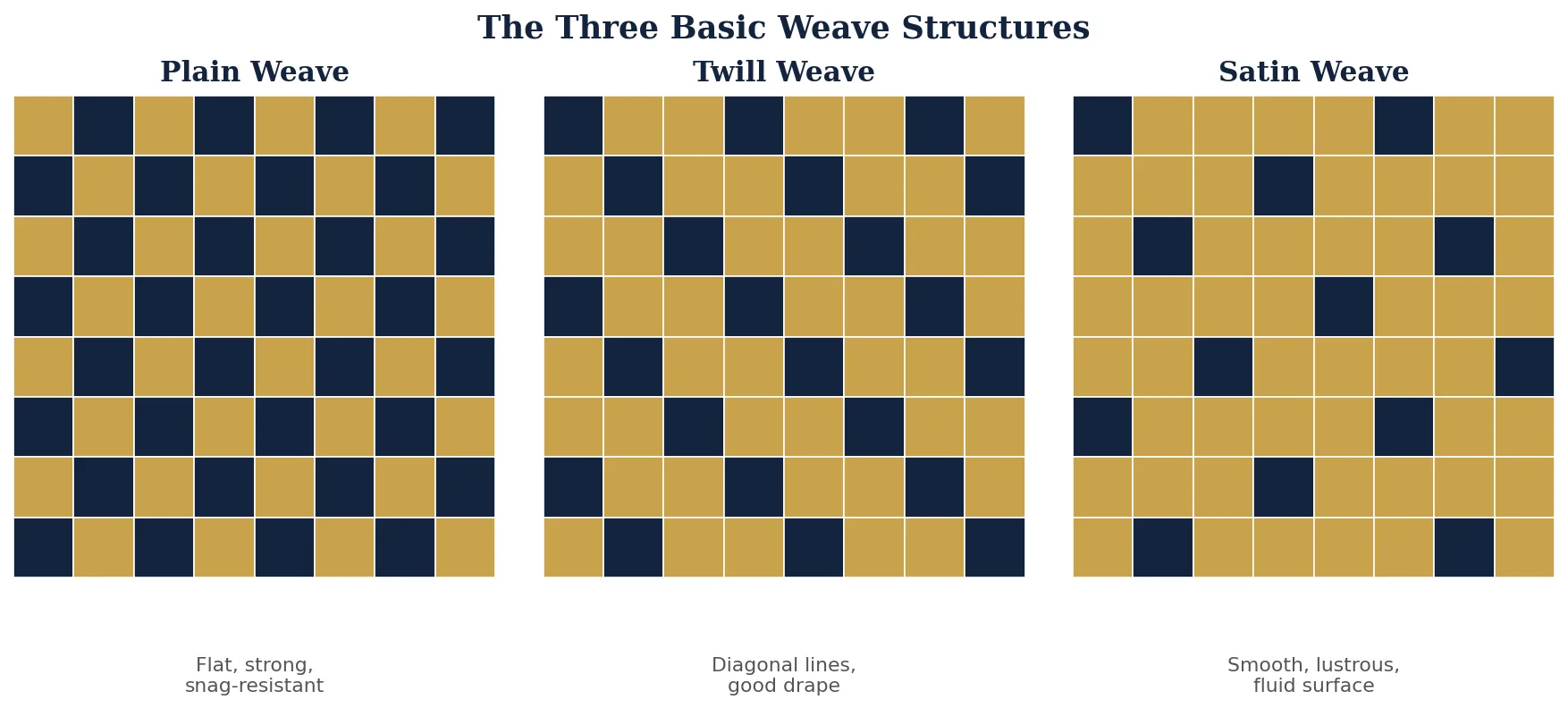
- Plain weave — yarns cross one over one. Flat, strong, and snag-resistant. Poplin, taffeta and canvas are plain weaves.
- Twill weave — yarns cross in a stepped pattern, creating diagonal lines. Good drape and a substantial hand. Denim, chino and gabardine are twills.
- Satin weave — yarns float over several others, creating a smooth, lustrous face with fluid drape. Sateen and satin use this structure.
Understanding the weave tells you a lot about how a fabric will look, feel and perform — before you even touch a sample.
Choosing the right fiber
There’s rarely a single “best” fiber — only the best fit for your application. The real skill is in the blend: combining fibers to capture their strengths while offsetting their weaknesses. Cotton-spandex for comfortable stretch. T/R for affordable suiting. Poly-cotton for durable, easy-care workwear. The right combination, woven and finished correctly, is what makes a fabric perform. And once you’ve specified a blend, it’s worth verifying the fabric you actually receive matches it.
At Yongbo Textile, we weave and finish across all of these fibers — cotton, polyester, viscose (T/R), nylon and spandex blends — with the dyeing and finishing controlled in-house. Tell us your application, and we’ll help you specify the right construction. 🌐 yongbotex.com