If you’ve ever asked a fabric mill for a quote and been told “our minimum is 3,000 meters,” you’ve hit the wall every growing brand hits: MOQ, the minimum order quantity. It can feel like the factory doesn’t want your business. The truth is simpler — and once you understand it, you’ll know how to work around it.
The core logic: it’s not “too small,” it’s “would lose money”
A factory’s MOQ is not about disdain for small orders. It’s a break-even point the mill has calculated. Below that quantity, taking the order loses money. Above it, the mill finally starts to profit.
So how is that number calculated? It comes down to three things: setup cost, waste, and scheduling.
1. Setup cost: the machine doesn’t care if it’s 500m or 5,000m
Whether you order 500 meters or 5,000, the mill has to do the same setup work before a single good meter comes off the line:
- Preparing and threading the loom, or charging the dye vat
- Color matching and mixing the dye/print paste to your exact shade
- Calibrating the printing screens or digital heads
- Running test lengths until output is stable
- The hours of technicians, machine operators and QC during all of this
This is a fixed cost. It’s the same whether your run is small or large — so the smaller your order, the more of it each meter has to carry.
A simple example: if dyeing setup for a color costs a fixed amount, and you spread it over 500 meters, each meter carries a heavy share. Spread the same setup over 5,000 meters, and it nearly disappears per meter.
- Small run → setup cost is a big share → higher price per meter
- Large run → setup cost is spread thin → lower price per meter
2. Waste: the invisible cost
From greige to finished fabric, some loss is unavoidable. Before the color matches perfectly, the first meters off a dyeing or printing run can be off-shade. Print registration takes a few meters to lock in. There’s head-and-tail fabric on every batch.
There are two kinds of waste:
- Fixed waste — from setup, color matching and trial runs. On a small order this can be a huge proportion of the total; on a large order it’s almost negligible.
- Variable waste — the normal defect rate during production, roughly the same percentage regardless of size.
The small-order trap: if setup-and-trial consumes, say, the first 100 meters of fabric, that’s a punishing share of a 500-meter order — but trivial on 5,000 meters. The mill has to price that waste in.
3. Scheduling: why small orders wait
A mill’s production lines are like a highway. Big orders are the trucks — one run, steady volume, efficient. Small orders are bicycles: they still need a lane, but earn far less.
So when the mill schedules production, the usual priority is:
- Long-term key accounts
- High-value large orders
- Time-critical mid-size orders
- Last: small-quantity, low-value orders
This is why small orders often have to wait — slotted into spare capacity after the main runs. And it’s why small-order lead times are less predictable, and why some mills are reluctant to take them at all.
How quantity affects your price (at a glance)
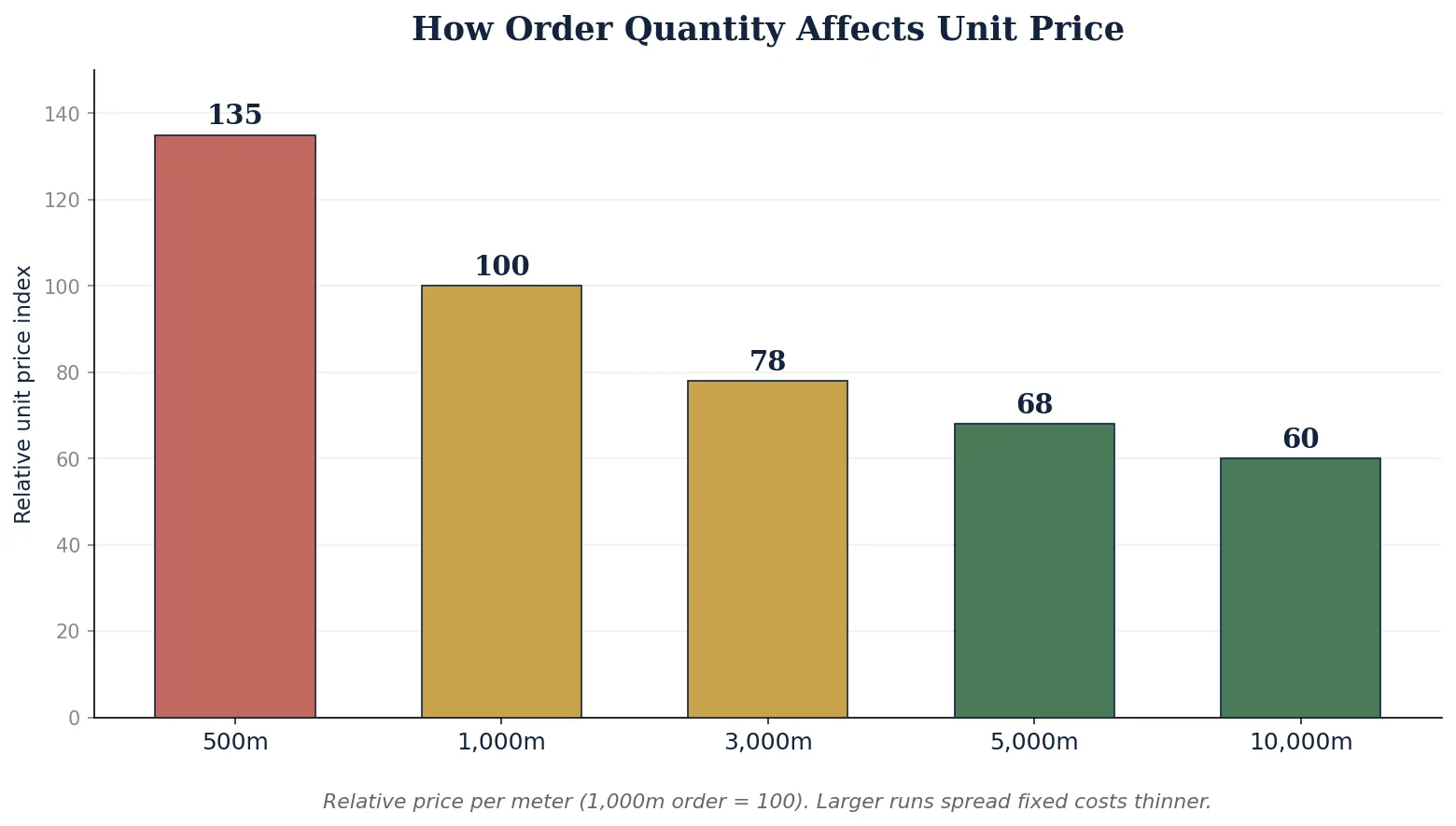
As the chart above shows, unit price drops steeply as quantity rises, because the fixed costs (setup + fixed waste) get spread across more meters. The jump from a tiny run to a moderate one makes the biggest difference; beyond a certain point, the savings flatten out.
Three practical tips for growing brands
1. Consolidate orders. Team up with a few brands ordering the same base fabric and place a combined order, sharing the setup cost and waste. Or ask the mill about stock/greige fabric and ready inventory — buying existing stock skips the setup cost entirely.
2. Use digital printing for small runs. This is the big one. Traditional screen or rotary printing has high fixed setup (screens, cylinders), so it needs large minimums. Digital printing has almost no setup cost — no screens to make — which is exactly why it can run small quantities economically. For small-batch and custom designs, digital is your friend.
3. Build a long-term relationship. Let the first small order run at thin margin for the mill. If your communication and payment reliability are good, a mill that thinks long-term will grow with you. As your volumes rise, prices come down and your orders move up the schedule.
Understand the mill, and you’ll source smarter
MOQ isn’t a factory being difficult — it’s the underlying math of manufacturing. Once you understand setup cost, waste and scheduling, you know how to negotiate, how to design around minimums, and how to plan your fabric budget realistically.
At Yongbo Textile, we work with growing brands, not just large buyers. Our digital-printed fabric starts from as low as 500 meters, and we’re flexible on customization and minimums where the construction allows. If MOQ is holding back your next collection, tell us what you need — we’ll help you find a workable way to produce it. 🌐 yongbotex.com